
Basket
There are no more items in your cart


Barbaresco DOCG 'Santo Stefano Albesani' 2020 (750 ml.) Castello di Neive
The Barbaresco DOCG Santo Stefano Albesani 2020 from Castello di Neive comes from a balanced vintage that ensured regular ripening and high-quality grapes. After fermentation in steel, it ages 18 months in French oak and further months in glass, gaining elegance, complexity, and aromatic depth. The Nebbiolo shows a bright garnet color and a broad bouquet with ripe red fruits, dried violets, fine spices, and light balsamic notes. On the palate, silky tannins, harmonious structure, and long refined persistence highlight the prestige of Santo Stefano cru. Perfect with braised meats, game roasts, and aged cheeses, it pairs with traditional rich Piedmontese cuisine.
- Product Category
- Red Wine
- Denomination
- Barbaresco DOCG
- Grape variety / Raw material
- nebbiolo
- Vintage or Cuvée
- 2020
- Format
- 750 ml.
- Nation
- Italy
- Region
- Piedmont
- Alcohol Content
- 14.5% vol.
- Service Temperature
- 18° - 20° C.
- Recommended Glass
- Wide goblet with a long stem
- Gastronomic Pairings
- Game meat, Red Meats, Aged Cheeses
- Allergens
- Contains sulfites (sulfites refer to sulfur dioxide that is added to wine to preserve it, thanks to its disinfectant, antioxidant, and stabilizing action)
- Overall Rating
- 94/100
CDN-BARBARESCO-S.STEFANO-2020
12 Items
Castello di Neive
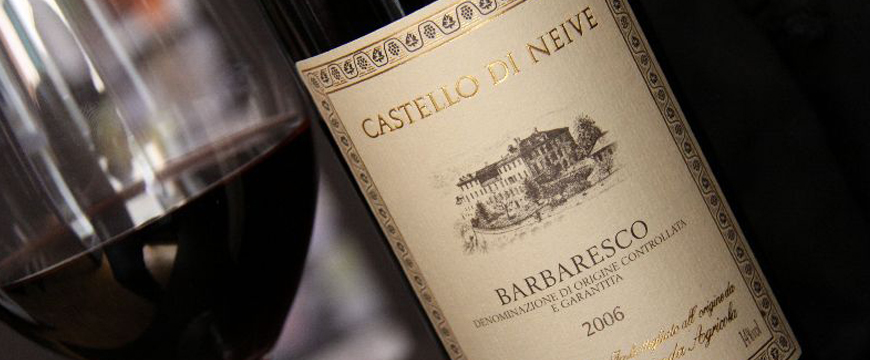
Nestled in the enchanting setting of the Langhe, the Castello di Neive stands as a guardian of history and tradition in the heart of Piedmont. This historic winery, overlooking the majestic Piedmontese hills, has been a cornerstone in the revival of Barbaresco, one of Italy's most celebrated and refined wines. The history of the Castello di Neive is intertwined with that of the Langhe region, a place where the passion for viticulture is passed down from generation to generation, celebrating the elegance and complexity of Nebbiolo, the prince of Piedmontese grapes.
In the heart of the DOCG Barbaresco, the Castello di Neive is expertly dedicated to the cultivation of Nebbiolo and Arneis grapes, two varieties that embody the essence of the region. The winery, with a vision that combines tradition and innovation, works tirelessly to produce wines that are authentic expressions of their terroir. Each bottle of Barbaresco Santo Stefano is a sensory journey, a story made of enveloping aromas and a refined structure, capable of transporting those who savor it among the sunlit vineyards and gentle breezes of the Langhe.
The Barbaresco Santo Stefano from the Castello di Neive is an iconic wine, a symbol of elegance and balance, appreciated for its notes of ripe red fruits, delicate spices, and a persistence that invites meditation. Each sip is a tribute to the land that created it, an experience that reflects the dedication and care with which it was produced.
Let yourself be seduced by the oenological treasures of the Castello di Neive on Vino45, and discover how this historic producer continues to write pages of excellence in the world of wine, celebrating the noble tradition of Barbaresco and the authenticity of the Langhe.
Address:
Via Castelborgo, 1 - 12052 Neive (CN), Italy
Color: bright ruby red with subtle garnet reflections, characteristic of young Nebbiolo
Nose: fragrant and refined, showing crisp red fruits such as cherry and raspberry, followed by floral tones of violet and rose, gentle sweet spice hints and light balsamic nuances
Taste: elegant and vibrant, with firm yet fine tannins, lively freshness supporting the structure, and a harmonious finish with fruity and floral echoes
- Kerin O’Keefe: 97 / 100
- Antonio Galloni: 95 / 100
- Wine Spectator: 94 / 100
Reviews
No reviews
Tap to zoom

THE WINE
The Barbaresco DOCG Santo Stefano Albesani 2020 from Castello di Neive comes from a balanced vintage that ensured regular ripening and high-quality grapes. After fermentation in steel, it ages 18 months in French oak and further months in glass, gaining elegance, complexity, and aromatic depth. The Nebbiolo shows a bright garnet color and a broad bouquet with ripe red fruits, dried violets, fine spices, and light balsamic notes. On the palate, silky tannins, harmonious structure, and long refined persistence highlight the prestige of Santo Stefano cru. Perfect with braised meats, game roasts, and aged cheeses, it pairs with traditional rich Piedmontese cuisine.
THE COMPANY
The Stupino siblings - Anna, Giulio, Italo, and Piera - are the owners of the Castle and about 60 hectares of land in Neive. They were all born at Neive As well as the parents, the grandparents, and the great-grandparents. The history of the company begins when their father, Giacomo, starts to make use of his experience as a surveyor and great connoisseur of the area, acquiring, where possible, land and vineyards in the best locations.
In the small cellars of the old Stupino house, the first production of wine for domestic consumption and bulk sale begins. Messoirano, Montebertotto, Basarin, Valtorta, I Cortini: the number of farms and vineyards purchased by Giacomo increases, as does production. And so, in 1964, the castle is acquired along with its spacious cellars and the farms Santo Stefano and Marcorino, as well as other lands that belonged to Count Guido Riccardi Candiani. This is the turning point that drives the organization of the winery, the renovation of the vineyards left to overgrowth by the old owner, and the production of wine using modern methods.
At the death of Giacomo in 1970, Giulio and Italo oversee the transformation from sharecropping to direct management of the properties, with the valuable assistance of Talin Brunettini, a skilled cellar master and expert in agronomic techniques. Thus begins the first bottling and the introduction of wines from the Castello di Neive in the world. In 1978, another great milestone: thanks to the collaboration between Italo and some prominent figures from the Faculty of Agriculture in Turin - Professors Italo Eynard and Annibale Gandini - the clonal selection of Arneis begins, a grape that had been abandoned and was almost unknown, of which the rediscovery... Castello di Neive played a central role.
In recent years, Italo has been directly and fully committed to the management of the company under the brand "Castello di Neive Farm Company": a commitment that seems to follow a premonition conveyed by the old photo (pre-war!) in which Grandpa Mentore shows him a bunch of grapes. The development of markets, especially foreign ones, has made it necessary to transform all the grapes from our vineyards. The spacious cellars of the castle could no longer accommodate such operations, so we decided, in the spring of 2012, to move the production operations, along with the machinery and stainless steel tanks, to a new technical structure - Cantina 2 - with a rational layout, concentrating all the large and small wooden barrels for aging wines in the castle's cellars."
Following a drastic restructuring and the refurbishment of the service systems.
THE PRODUCTIVE PHILOSOPHY
The mental framework acquired at the Polytechnic University of Turin, along with activities in other sectors, has led Italo to a 'scientific' approach to farming and viticulture. Tradition is important, but one should not take everything for granted. Doubt, research, comparison, synthesis. In this way, since the 1970s (with the 'rediscovery' work of Arneis mentioned in relation to the Montebertotto vineyard), the proximity and collaboration with the Faculty of Agriculture in Turin have allowed Italo to enter the world of vines and wine through the right door, preparing him to face the challenges and changes of an ever-evolving market.
Tradition, research, and creativity: this is the philosophy of a company that, without neglecting centuries of experience in the field of viticulture, embraces new technologies, is committed to research – both in the vineyard and in the cellar – and is ready to take risks by courageously experimenting with new methods. It is this enthusiasm and creative energy that have given rise in recent years to some new and stimulating experiences: starting from 1995, the company has produced a fabulous classic method sparkling wine obtained exclusively from grapes. pinot black, the 'Castello di Neive Classic', in addition to the 'Castello di Neive Passito made from dried Arneis grapes. Starting from 1996, the company created two wines aged in barriques - 'I Cortini', made from grapes. pinot black, and 'Barbera d'Alba Superiore', from barbera grapes; since 2006, Albarossa has also been produced.
THE PEOPLE
The collaboration between the Castle and the Faculty of Agriculture of Turin continues to this day with Professors Vincenzo Gerbi and Silvia Guidoni, to whose research, in the cellar and in the vineyard, we provide maximum support, convinced that there is still much to study and discover about the vine and wine.
In this action, the consultations of the winemaker Gianfranco are of great assistance. Cordero and the agronomist Dino Bevione. The ultimate authority is the winemaker Claudio Roggero and his right-hand man Marco Ion.
In other words, this is the guiding idea and this is the team of Castello di Neive that puts it into action.
The promotion of the wines produced, in Italy and abroad, is directly managed by Italo Stupino with the support of his daughter Carolina.
THE CASTLE
Neive its name to a noble and important Roman family, "Gens Naevia" or "Naevii," and became a municipality towards the end of the 12th century. An initial castle, located at the top of the hill, already existed at that time but was destroyed in 1274 during a retaliation. After being under various dominations, in 1530 the territory became a stable domain of the Savoy and under Carlo Emanuele I it was transformed into a fief granted to Marquis Vittorio Amedeo Dal Pozzo, who took on the title of the first Count of Neive.
At the beginning of the 1700s, Count Castelborgo, lawyer Manfredo Bongioanni, decided to build the new castle on foundations dating back to the 1500s/1600s. The imposing structure occupies the southwest boundary of what was the medieval refuge of... Neive and a defensive wall (1750) with watchtowers connects the castle and the gardens to the South Gate of the town, known as San Rocco (from the votive chapel of the 15th-17th century located just outside the village enclosure).
The construction took several years, and a completion date can be established in 1753, the year of the inauguration of the beautiful internal chapel, as indicated by a plaque inside the chapel itself. The baroque altar, rich in marbles, is remarkable and quite unusual in a private residence. The castle's cellars – where the production and bottling of wine still take place – were built with this function in mind. They indeed have a considerable height to allow for the use of large barrels. In these cellars, serving the Count of Castelborgo, worked the winemaker and merchant. Louis Oudart who equipped the winery and who, for the first time in the area, produced a dry, stable wine with the nebbiolo grapes, which was marketable, bearing the name 'NeiveHe won a gold medal at the London Exhibition of 1862. With the same techniques used by Oudart for the 'NeiveThirty years later it was produced in the castle of Barbaresco the first Barbaresco...if it had not been so, Neive Today it would enjoy much greater fame!
The rest of the structure is partly intended for the residence of the Stupino brothers and partly for representation: one can see the hall with early 19th-century decorations in the Empire style of the Return from Egypt, the music room, the dining room, and the gallery.